Quilting is more fun with friends. But did you know that there are more ways to quilt with friends than simply going to a retreat? (But you should definitely still go to a retreat because they’re amazing… What about our Bar Harbor retreat?)
Introducing… Group quilts.
It’s always good to mix things up… Heaven forbid the hobby you love gets boring. Group quilts can offer an easy, fun, and creative way to do some quilting, while also taking some of the pressure of completing a full quilt off your shoulders.
Generally, if you quilt with the same people long enough, you’re bound to decide to do a group quilt at some point. Just let it happen.
There are a number of reasons that quilters decide to do a group quilt:
- A donation to charity
- A raffle draw
- A showcase
- A pandemic hits, and there’s nothing else to do
Story time! Let me introduce the Block of the Month gang.
As many people did… we started during COVID. We were bored and passionate quilters. Everyone who wanted to join in signed up and got assigned a month.
When their month came around, they would email out a block pattern and tell everyone what they wanted for fabrics and colors. The other quilters would each make a block and send (or give for those of us who were local) it to the person who sent the pattern.
And this is still going!
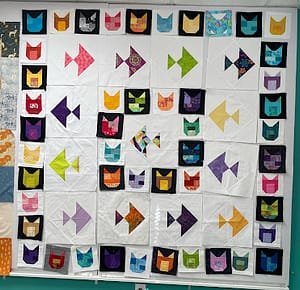
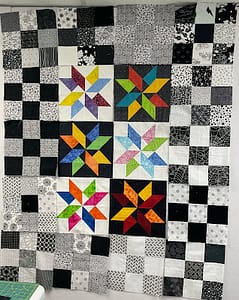
Honestly, I’m (Wendy) still working on figuring out what I want for a layout for mine… I’m putting all of my blocks together to see what I can come up with. So far, these are the two I’m liking the most for the majority of the blocks. What do you think?
Andrea has also done a group quilt project called the Seven Sisters Group Quilt.
Some of the women in my (Andrea) quilt guild chapter wanted to create a challenge together. We consulted a few books on group challenges and decided to work on a round-robin challenge and customize the rules. We ended up with seven women participating, so we called it "The Seven Sisters Challenge." My mom, Jill, was a member of the chapter, as well, and participated in the challenge, so the "Seven Sisters" pictures include my finished challenge quilt AND hers.
For the challenge, each quilter put together a project box containing any/all of the following:
- Instructions about the type of blocks desired, the colors/kinds of fabrics to be used, etc.
- Patterns for the blocks desired
- Fabric to be used and/or matched
The instructions could be either strict or loose guidance. The other quilters would follow the instructions in each quilter's project box. Some of us wanted only our provided fabric used, while others provided no fabric and gave the other quilters complete design freedom. Some of us wanted only specific blocks included—and provided patterns—while others made some suggestions and allowed the other quilters to have a freer hand.
Each month, the boxes rotated according to a schedule that ensured that the box's owner did NOT get their box back until the very end. We were not allowed to see our own box's contents for the 6 months that they were rotating. During each month, the quilters would create the blocks specified in the instructions of the box they received. At the end, we had a meetup where each quilter got her own box back and all of the beautiful blocks made by her "sisters" were revealed.
Andrea's Seven Sisters Group Quilt


Jill Ames' Seven Sisters Group Quilt


Step-by-Step guide for doing a Group Quilt:
Step 1: Choose a Group Leader (aka Your Quilt Boss)
Before anyone touches fabric, choose a group coordinator (or two). This person (bless them) keeps the project moving and everyone on track. I know it’s way more fun just to dive right into the project, but trust me, do this first.
Duties of the group lead:
- Coordinates the overall plan, deadlines, and design
- Tracks who’s doing what
- Sends reminders (friendly, possibly sassy, but always fun)
- Collects blocks and stores the quilt during production (if you’re doing one group quilt for a specific purpose)
- Keeps morale up with motivational memes
Optional but helpful: Have a co-lead to share the load—especially if you’re working with a big group or across distance. It can be helpful to pick two leaders in places with a number of people who are working on the quilt.
Step 2: Define the Purpose of the Quilt
You’ve got to know what you’re working towards (even if it’s just for fun). Why are you making this quilt?
- A gift for someone special?
- A show?
- A fundraiser or auction item?
- A group learning experience or guild project?
- Just for fun? Even boredom?
Knowing the goal helps determine the design, tone, timeline, and who needs to be involved. This helps guide the designing process. We always love it when these things are smooth sailing.
Step 3: Choose a Design, Theme, or Layout
This can be a collaborative decision or one made by the lead with input. If you’re making just one quilt, get a design agreed upon. If you run it like Wendy’s block of the month, then the person whose month it is will decide.
But make sure everyone knows what they should be making… Otherwise, it’s kind of messy.
Popular formats:
- Sampler Quilt – Everyone makes a different block or a certain number of blocks (works if not everyone is local)
- Row Quilt – Each person makes one row (works if not everyone is local)
- Color Theme – Everyone uses a shared palette
- Block Quilt– Everyone makes blocks, and one person all of the blocks that month (block of the month. Each month, everyone makes a block and sends it to the person whose month it is)
- Signature Quilt – Includes names, messages, or embroidery (see the Seven Sisters quilts for names!)
Choose a design that works for your group’s skill levels and timeline.
Step 4: Set the Quilt Size & Block Dimensions
Get clear on the nitty-gritty. Yes, we are all creatives, and it can be a drag to talk details (or not if that’s your jam!), but this is crucial.
- How big is the quilt going to be overall? (It’s always awkward to be that one person who shows up with a block or two that’s too big!)
- What size are the blocks? (e.g., 12.5" unfinished)
- How many blocks will each person make?
Put it all in writing (yes, seriously) and send it to the group. It’s important to get this in writing, especially if you’re making a quilt for a raffle, charity, or some kind of show. You’re sending this out into the world, so it should be as good as you can make it.
Step 5: Pick a Color Palette or Fabric Guidelines
Keep it cohesive:
- Use a shared color palette, fabric line, or background color
- Use the same background fabric
- Use a focus fabric and decide on which colors to match (the team lead or the person whose month it is can choose this)
- Decide who’s providing the fabric (from the stash, provided kits, go out and get the specific fabrics and colors, etc.)
- Provide visual examples or swatches for clarity. For block of the month, we send out the specific pattern we would like
- Choose a particular fabric (eg, high-quality cotton)
 Pro tip: Send everyone a palette photo or paint chip card as a visual reference. Choose a tame pattern or a popular color scheme, especially if it’s going to be used for charity or sold. It’s better to do this than simply send a photo because the colors can morph in a photo, especially from a camera phone.
Step 6: Assign Roles, Responsibilities & expectations
Let’s be real—group quilts need structure. The actual roles available for the project will depend on the purpose and structure of the group quilt. Here’s how you can divide the work if it’s for a complicated project with a lot of moving parts:
Suggested Roles:
- Block Makers – Most of the group
- Block Tracker – Keeps tabs on who’s completed what and follows up if needed
- Block Trimmer – Makes sure all blocks are uniform size
- Top Assembler – Person(s) sewing blocks into rows and rows into a quilt top (for block of the month, the person who received all the blocks sewed them together)
- Quilter – Either someone in the group or a hired longarmer
- Binder – One or more people to bind the quilt and stitch the label
- Label Maker – Gathers names, dates, a message if needed, and creates the label
- Storage Coordinator – The designated person who holds onto the quilt (and doesn’t forget where they put it… Necessary for things like raffles and showcases)
- Communicator – Keeps the group updated with deadlines, progress, and occasional pep talks (IYKYK)
If you’re at a retreat or sewing in person, some of these can happen naturally. If working remotely, it’s extra important to assign these clearly!
Step 7: Set Deadlines & Communication Methods
- Create a timeline for each stage: blocks due, top assembled, quilting finished, etc. Nothing is worse than waiting on a handful of people and making the team lead have to constantly chase people. Or getting behind and having your blocks pile up.
- Choose how the group will communicate (email, group chat, Facebook group, Google Doc, video chat, etc.)
- Send reminders! People are busy. Life happens. A friendly nudge can work wonders.
Step 8: Collect & Store Blocks
Make it easy for people to send in their work if you’re not local:
- Set up a central drop-off or mail-in option
- Ask makers to label their blocks (name & top of block)
- Store everything in a labeled bin or clear container (NOT in a grocery bag on the floor of your sewing room…)
Bonus: Have a designated “checker” to square up blocks and make sure they’re all the right size before assembly. If you’re structuring like the block of the month, the person whose month it is is taking on that job. If you want your blocks, you’ll ask.
If you are doing this with a local group, decide who is going to store the quilt in the process of it being made, if it’s being given away. Everyone can store their own blocks while they’re making them, especially if they’re making them at home. But once you start sewing the blocks together, make sure you know where the quilt is going to be stored, especially if it’s not going to be with the person binding.
Step 9: Assemble the Quilt Top
Choose one or two people to do this part—less hands, less chaos. Also, better for consistency.
Steps:
- Have everyone bring in (or mail in if they’re not local) their finalized blocks
- Lay out the blocks (use a design wall or floor)
- Play with placement to balance colors and print scale
- Decide together or via video chat, the final layout and then take photos so you remember (unless it’s staying on a design wall). Trust me, take the pictures. It would suck if you forgot and had nothing to look back on
- Sew into rows, then rows into a top
- Press seams carefully
Optional: Add borders, sashing, or cornerstones if it suits your design. Depending on your structure, your steps might change. But for a standard raffle item, this works great.
Step 10: Quilt It!
Decide who’s doing the quilting:
- Machine quilted by a group member
- Sent to a longarmer
- Hand-tied or hand-quilted together at a group sew-in
Pick a style that enhances the quilt without overwhelming it. Once again, too many hands mean potentially inconsistency in the finished product. Choose wisely.
Step 11: Binding & Labeling
- Bind the quilt (machine or hand, solo or in a team)
- Add a label with:
- Who made it
- Why it was made
- Date completed
- Any special message (if gifting)
Quilt labels = love notes for the future.

Step 12: The Reveal & Celebration!
Whether you’re giving it away or keeping it in the group:
- Take photos of the finished quilt (and the group!). Memories are the best
- Share the story behind it on social or in your guild (A Facebook group or Instagram account can work well)
- Plan a little celebration or “unveiling” moment (If you’re doing a showcase, it can be fun to unveil to your group before it’s unveiled to random people)
- Bring snacks. Always snacks.
 Final Thoughts:
 Final Thoughts:
A group quilt is a beautiful thing. You’re looking at community, accountability, and a multitude of inside jokes. There’s something about quilters—IYKYK.
Sure, someone might turn in their block late. Someone else might make a block too big. But in the end? It’s kind of all worth it to be working together on the same goal. And in the case of block of the month and Seven Sisters, everyone gets a quilt they love made by a bunch of their favorite people. Can’t go wrong with that.
What’s great about group quilts is that you and your team make the rules. The steps above might work for getting started, but as you can see by our group quilt examples, there are lots of different ways you can go about doing it. Honestly, that’s the best part. Who likes rules anyway? Remember, these are just suggestions, but if it doesn’t work for your particular project, then create some steps that do work!
 Ready to build your first (or twentieth) quilt project? Join us at our next retreat—where we chat and laugh just as much as we quilt, but we sure never forget the good times. [Check it out now]
