
Okay, I’ll be honest with you… The one thing that is guaranteed to make quilters lose their minds is intersections. (Hello, nesting seams)
Few things in quilting are more satisfying than perfectly lined-up seams. When you finally nail it, it feels so good. It also makes things so much easier.
No one wants to redo a wonky seam. Ain't nobody got time for that, as they say.
In quilting… There are few things that annoy the crap out of us more than our points not matching, bulky intersections, and seams drifting apart after sewing. When I say lose our minds, I’m not even exaggerating.
There are many quilters who think that getting those perfectly lined-up seams and flat intersections is about becoming a perfectionist or having insane natural talent. Maybe you’re sitting there thinking you likely have to sew at a snail's pace, or you were just born with a God-given gift of sewing.
But here’s the real secret…
You don’t need either of those things.
It’s not about perfection or talent.
Most of the time, it’s actually simply just about seam management.
Nesting seams is one of the simplest ways to improve your seam accuracy. Honestly, it’s not hard at all. A tiny touch of patience and you’ll be nailing nesting no problem.
Nesting seams is when you essentially “lock” your seams together naturally before sewing. Instead of winging it, you just take 2 seconds (literally!) to get them aligned, and there is no way you’ll end up with wonky seams.
At the end of the day, nothing humbles a quilter faster than realizing their beautifully pieced blocks are somehow not meeting in the middle. Don’t let this be you.
Learn how to nest your seams with just a few simple steps.
So, what does nesting actually mean? Nesting is when two seam allowances are pressed in opposite directions, so they fit tightly together, perfectly.
The idea is that one seam goes left, the other goes right, and when you lock them together, they become a perfect match, and your seams align with perfection without having to become a perfectionist. You still have fun, but your block looks uber professional.
It’s such a simple step… Why does it even matter?
Here’s the thing with quilting: You start by making small, individual blocks that eventually lead to becoming an entire quilt. And the most annoying thing is when you get going and let one small wonky seam go, and suddenly your entire quilt is just not working. No one wants to have to redo all of their hard work.
A well-nested seam:
- Reduces the amount of shifting while you sew
- Helps your intersections line up more accurately
- Creates flatter joins with less bulk
When is nesting seams necessary? You’ll want to use it for:
- quilt blocks
- rows
- checkerboard-style layouts
- anything with repeated intersections
Nesting seams isn’t about forcing the seams into submission. You’re simply suggesting that they smarten up and cooperate for once.
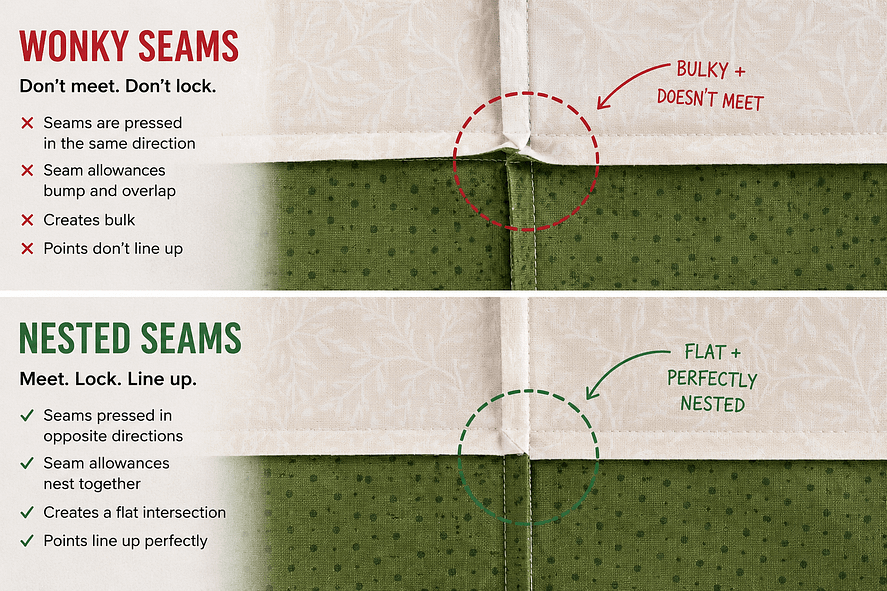
So, how do you feel the lock when your seams are nested properly?
Is it a feeling? Do you have to look for something specific? Is it some kind of psychic intuition thing, like the quilter's “force”?
When seams are nested correctly:
- they physically butt up against each other (yes, you can actually feel them stop being able to move)
- you can feel them “click” into place (not a sound, but definitely a feeling, and yes, you can actually look down and see them perfectly lined up.)
The idea is to slide your blocks together (one with the seam going left and the other going right) until you feel the resistance (you’ll be stopped from sliding). Your seams will stop sliding around, and your intersection will feel stable.
Then, take a quick peek and make sure your eyes agree with your fingers.
Once you feel the lock, you’ll suddenly understand why experienced quilters get weirdly excited about intersections. Suddenly, you’ll be one of us, cheering when we nail it.
Try these Pinning Strategies That Don’t Distort Your Blocks To Nail Nesting Seams
Once you have your seams nested, pinning it will become your lifeline. Do not feed it through your machine without a pin. Trust me, you’ll strongly regret that choice. You’ll want to make sure that once you find that beautiful sweet spot, you’ll be able to keep it together while you slowly feed the block through your machine.
Tip 1 — Pin Directly Through the Intersection
Place the pin straight through the exact seam intersection. Some quilters prefer vertical pins and others horizontal, but if you’re just getting started, try a diagonal pin.
Start with your pin going through the top with both seam allowances anchored. Go underneath your stitch line that’s directly in the middle, and then go right out the other side.
This helps hold your points precisely in place. You have your pin through both of your nesting seams, so there’s no wiggling.
Tip 2 — Don’t Stretch the Fabric
Here’s the thing: Pulling your blocks to “make it fit” distorts your blocks. Distortion often causes mismatched points later. That’s not what you want. You want your quilt to look effortless and professional with no wonkiness or bulkiness. Just straight seams and comfort.
Instead of stretching and pulling to get that perfect puzzle-piece “lock,” just let your seams sit naturally, and pin them where they are happiest.
You might need to try a few times to get the technique, but once you get the hang of it, it becomes second nature.
Tip 3 — Use Fewer Pins Than You Think
Over-pinning can create shifting and bunching. One or two accurate pins are better than five panic pins. If you find that things just aren’t lining up, take a breath and use your fingers to get things aligned.
If one isn’t enough, try to align the top by gently working it with your fingers, and adding two stitches to keep it together. Then, gently work the bottom with your fingers and add one more pin to align that.
Aggressively pinning your quilt into submission rarely improves the situation. In this case, less is better… Unlike your tea collection and pet cats.
Tip 4 — Sew Slowly Over Intersections
Intersections are bulkier because that’s where both of your seam allowances are. Slowing down improves your control and ensures you don’t have to do a redo after you finish.
Nothing about quilting is quick. While it would be nice to be able to just cruise through a quilt and have a perfect one at the end, that’s not how we roll. So, slow down and take your time. Your machine has to stitch through more fabric at your intersection, and it’s a critical, make-or-break spot.
Pro Tip: If you need some extra support, you can use a stiletto or seam guide. This way, things are lined up and accurate to avoid any little mistakes in nesting seams.
Perfect Intersections Aren’t Magic (though we absolutely wish they were when it comes to nesting seams).
Matching your seams is a skill, not luck. It’s not about ingrained talent or “close your eyes and hope for the best”. It’s about practicing something until you get the hang of it. Not in a perfectionist way, just in a “hey, I didn’t blow it” kind of way.
Nesting seams creates:
- accuracy
- flatter blocks
- cleaner finishes
But even experienced quilters occasionally lose points. No one gets it 100% every time. Everyone has those, oh crap moments where we finish sewing, flip it over, and think, “how on earth did I ever think that was straight?”
Progress matters more than perfection.
Small techniques create huge improvements over time. While nesting seams might seem so simple and not even worth reading about, it’s these little skills that will save your butt with every block.
And honestly? Few things in quilting feel more powerful than flipping over a block and seeing those seams line up beautifully. It really does deserve a happy dance.
And, if you need, there’s always someone at retreat willing to lean over your shoulder and say, ‘Press that one the other way, or pin it like this’. Trust me, those people will become your heroes.
There’s nothing like those Maine beach views to get your creative juices flowing. Registration is open now!
